Friday, January 30, 2015

Week Four: Marketing Plan- The Launch (2 of 3)

     The first part of this marketing plan was for an artist to have a strong online presence. The second part is about how an musician can create a successful new release launch.
     It is important for an artist to realize that digital distribution can spread their music faster then a physical CD or selling MP3s on the artists website. Music is for the fans. Digital distribution allows a musicians music to be available when and where fans want it, 
ewfwefwenobody has the same preferences! Some will prefer streaming the album like Spotify and some will buy it permanently on platforms like iTunes and some will go to a digital distributor like CD Baby. However, musicians need to be careful and not sign up on too many, one is an acceptable amount. They want their song to be available but not have multiple copies of the same album on all the digital retail stores.This is another reason for a musician to have a strong online presence. 
     The album is just the beginning. "The release of the actual music itself is one big event, and this album/EP as a whole represents your main content that will be used in an effective launch campaign." To support the release, going on tour, creating a music video, and designing merchandise are many assets artists should use to draw attention to the release. Musicians should reach out to press and share information with their current following to help spread the word.                                                                                                                             jhbWhen releasing albums or EPs, artists should have a tour booked.  The artist can either do a international tour that goes around the world, a national tour that goes around the United States or a mini tour that is regional. Going on tour will help with an artists press. Local newspapers are more likely to talk about new music if the musician is coming to that specific town. When an artist has a list of tour dates, audiences view them as credible and that the artist is active and working hard to promote their career.                                                                                                                             
     "A music video that is captivating, colorful, funny, interesting (the list goes on, but you get the idea) greatly helps with a press campaign." Creating a exclusive premiere on a website will generate a buzz on social media. On the other hand, while giving the music video before dropping an album helps with promotion, so will releasing it a month or two after the album comes out. This method will build awareness. At least one official music video needs to be made for an album, more than one is preferable. The concept of creating an official music video is to build a fan base and to grab listeners attention. 
      Merchandise is a fans and artists best friend. Fans love merchandise because it supports the musician, and shows that they went to their concert. Artists love merchandise because they make money, and it is promotes them. When deciding on what merchandise to sell, artists should listen to their fan base. If their fan base loves shirts- they should create some shirts. If their fan base loves jackets- they should definitely create some jackets. However, if a musicians fan base isn't sizable, then they should not sell merchandise, only to be most cost effective.                                                               ljkj  When promoting a new album or EP, an ample component is the artists press campaign. The musician can either use a public relations company, also known as PR, or do it themselves, also know is DIY. When using a PR company, musicians should look for ones that fit their music. The company should have a thought out plan to promote the artist. Little details about musicians can push a campaign into the spot light. Artists should talk more about hobbies, preferences, and family stories.        
                 Your pre-luanch timeline
Two Months Before Release
  • Press campaign begins
  • Release a single, a great way excite your fans and also to get some current press quotes to include when contacting press about the full length release
  • Reskin social media profiles to advertise the new release
  • Get your newsletter firing and tell fans you have a special announcement
One Month Before Release
  • Announce pre-sale campaign through your newsletter and social media networks- create bundles of merch to sell for extra boost
  • Set up a Facebook invite for the new release, send it to all your Facebook friends and post on your Fan Page
Two Weeks Before Release
  • Keep the excitement going, hold a contest to win a copy of the new album and/or tickets to the release show
Official Release Day Activities
  • Write a news post about the release on your website or blog
  • Update Twitter and Facebook with an “album out now” post and link to where they can purchase it  (I suggest you pay to boost post so people see it!)
  • Send out a Newsletter to your mailing list
One Month After The Release
  • Service press with official music video and announce tour dates
The Musician's Guide to Creating an Effective Music Marketing Plan (Part 2 of 3) - CyberPR Music. (2014, October 7). Retrieved January 30, 2015, from http://cyberprmusic.com/2014/10/07/musicians-guide-creating-effective-music-marketing-plan-part-2-3/

Friday, January 23, 2015

Week Three:Marketing Plan- The Online Presence (1 of 3)

     A marketing plan is very important for an artist. Artist work long hard hours writing and practicing songs and spend tons of money recording and mixing the songs. As a reward, artists should have a thorough plan on how to sell it. With todays technology, an artist should make a online presences. "Time and energy needs to be spent building a strong online presence in order to be taken seriously as an artist for when the time comes to start actively promoting." There are tons of places online that artist make an appearance on, but the most influential: official website, a Twitter, a Facebook and YouTube. "An artist needs to be working many different angles and taking many different approaches to get seen and heard."
     An official website, no matter how famous the artist already is, is crucial. The artist website needs to be functional and modern. "The music industry is built on appearances." The website should have a spot where people can listen and buy music, but not a player that plays automatically when a person lands on your site, a news section to keep fans in the loop about whats new, and a newsletter sign-up with an incentive such as discount on merchandise or a free song. Also, a link to the artist social media accounts is recommended. It is important to NOT substitute social media for a website. 
     Twitter is the best platform to help an artist build a following. Artists should follow everyone: friends, musicians, producers, club owners etc. Since Twitter has no following limit, artist should follow other artists with similar sounds. Similar sounds means similar tastes which means that they could like the artists music. On a Twitter account, it gives the option to upload a picture for a cover photo and a profile picture. For the cover photo, an artist should upload a picture that says something about that particular artist and their music. The cover photo is a secret advertisement. " 
A simple solution is to use a publicity shot with text on top of the image that promotes anything on the horizon like single, EP, or album releases, new music videos and tour announcements." Artist should tweet daily, and choose different topics such as career news (which should be no more than 20% of your output) to your interests, passions and hobbies. If an artist is looking for responses, news, politics, sports, culture are great topics to get their audience to engage.
     A Facebook Fanpage has a pay-to-play reality to get maximum exposure. To look professional, an artist should have daily posts on their Fanpage. "Posts that are not just text will have a greater chance of being seen, so share photos and links as much as possible and ask questions to increase engagement."The cover page on a musicians Fanpage has the same effect as the Twitter cover photo, use it as an advertisement! On your Fanpage, three apps should be installed: artist profile, a store and a mailing list sign up form. 
     YouTube is a very powerful platform where artists are getting seen and discovered. With music being the number one type of content being streamed, YouTube is the first place millions of people worldwide go when they’re looking for online video. It is a necessity for a musicians channel to look professional. On a musicians channel, there should be a branded cover image and links to their other 
social media profiles so people can connect with the musician across different platforms. For the actual music video themselves, it is fundamental that the artist name is with the music video title, for example, 'Taylor Swift-We Are Never Getting Back Together.' The tags musicians chose should be adjectives that describe the musicians music and similar artists as keywords with an artist name also being a keyword. Under music videos, there's a description box. In the description box, artists must tell viewers what they are watching and provide links to other content they own, such as their website and iTunes, where they can go for more music and learn more about the musician. 
     'Hello, you've got mail!' Newsletters are the easiest way for a musician to keep their fans up-to-date. Once a month, musicians should write letter regarding all things them. This letter is where artists see the biggest impact on sales. 

http://cyberprmusic.com/2014/09/10/musicmarketingplan-1/
The Musician's Guide to Creating an Effective Music Marketing Plan (Part 1 of 3) - CyberPR Music. (2014, September 10). Retrieved January 23, 2015, from http://cyberprmusic.com/2014/09/10/musicmarketingplan-1/

Friday, January 16, 2015

Week two: The Times They Are A-Changin'

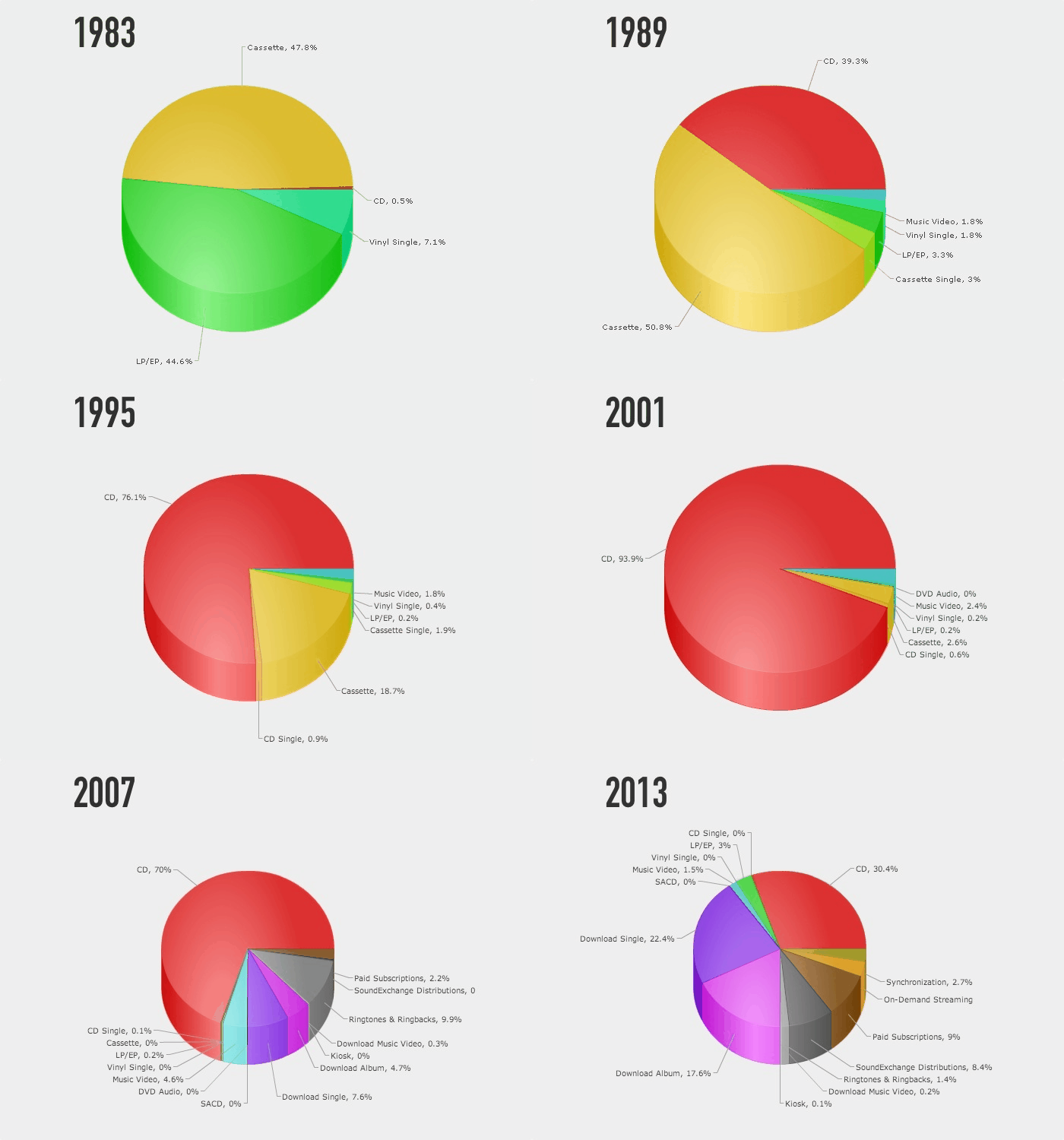
          The music industry has gone through makeovers many times in the past decades. In the 1980's, music was distributed through compact disc. Then came vinyl, then came cassettes and so on and so forth. But now with the digital age, music distribution is mostly online or accessed through apps. In the last several years, there has been a 7 to 10 increase in sales of subscriptions for streaming. According to the International Federation of the Phonographic Industry, the music industry's digital revenue grew to $5.9 billion dollars in 2013. "The IFPI also reported that digital downloading remains a key revenue stream for the industry. Downloads account for 67 percent of digital revenue, said the study." However, that doesn't mean that the physical music formats like CDs are dead, in 2013 51.5 percent of all global music revenues came from physical music platforms. Robert DiFazio, a faculty in Columbia’s Business 
Distribution trends of the last 30 years
& Entrepreneurship Department, has said that one of the biggest changes the industry has endured is that consumers can download one particular song instead of buying an entire album. With distributors offering consumers to buy one song instead of the whole album, the amount of money artists receives have also changed. "'It’s a lot more difficult to make your living off the sale of your recorded music products unless you are in the rarefied air of an artist who is widely recognizable,' DiFazio said. 'Becoming a recognizable artist is what most people want, and profiting from the sale of your recorded music product on your way to becoming recognizable is almost impossible.'" 
   Throughout the years, technology has improved and has grown world-wide. From here, it can only get better.Understandably, the revenue from digital distribution has went sky high from all of the different streaming outlets available. However, there is evidence to prove that physical platforms aren't "dead and gone." And I believe that they never will be. Some people just like the tangible feel of a CD. And some people are just old fashioned and like a hard copy.

http://www.columbiachronicle.com/arts_and_culture/article_c72b6a24-5101-11e4-953c-001a4bcf6878.html

Downloading, subscription services changing music distribution. (2013, October 13). Retrieved January 16, 2015, from http://www.columbiachronicle.com/arts_and_culture/article_c72b6a24-5101-11e4-953c-001a4bcf6878.html

Thursday, January 8, 2015

Distribution Company Or Devious Criminals?

          “Each time there is a new way for an artist to make money, a new way emerges for others to take it from them.” It is shocking to learn that with todays rights and laws that a music distribution company can take a percentage out of a artists pay checked they earned from YouTube. Companies schemes work by them claiming that they, not the musician, own the rights to the recordings for licensing into videos on YouTube. The fact is that distribution companies don't own the licensing to the music artist create. On YouTube, there are different ways to make money. The first is from views of your own videos - this is called a channel. The second is from views of videos which use your music - this is a claim.          
          The best way for an artist to keep their money is doing it themselves. On the channel, if a musician wrote a song, recorded it, and made a video, like an official music video, they would have the copyrights for the video, the recording of the song (the master), and the lyrics and melody to the song (composition). Once the video is add to your channel you can post ads with it. When the ads generate money, YouTube pays the artist about 55% of what they received from the advertiser. On the other hand, musicians can use claims to gain revenue. However, distribution companies have a contract with YouTube that allows the distributors to tell YouTube that they control the rights to the music of a song

being used. Theses contracts are called 'direct licensing contracts'.With these contracts, the distributor  

can create ads on the musicians videos and create their own revenue from the ads. Now, the distributors


have the artists money, the take a cut of whatever percentage they want. They mislead the artist by

calling it a distribution fee. "Let’s be clear.It is NOT a distribution fee,

the distributor did not “distribute” anything to YouTube. It’s a

'we’re taking a piece of your revenue because we can' fee."

          Jeff Price, the author of this article, has created two foundations- TuneCore and Audiam.

TuneCore was the original one Prince founded but it turned dirty because the investors did have the

artists best interest in mind. He then created Audiam that give musicians 100% of the revenue from the

views they receive on their own views as well as other peoples videos. I think that by giving musicians

the proper amount of money for what they created will help the music industry. If musicians get a

amount of money they deserve, they will create more music which will help the industry.


http://www.digitalmusicnews.com/permalink/2013/08/13/stealingartists
This Is How Distribution Companies Are Stealing Artists' YouTube Revenue... - Digital Music News. (2013, August 13). Retrieved January 9, 2015, from http://www.digitalmusicnews.com/permalink/2013/08/13/stealingartists